
Paddle Board Size Guide: A Comprehensive Overview (Updated 12/22/2025)
Navigating the world of stand-up paddle boarding (SUP) requires understanding board sizing, crucial for stability and performance. Weight capacity, dimensions, and type all influence the ideal SUP choice.
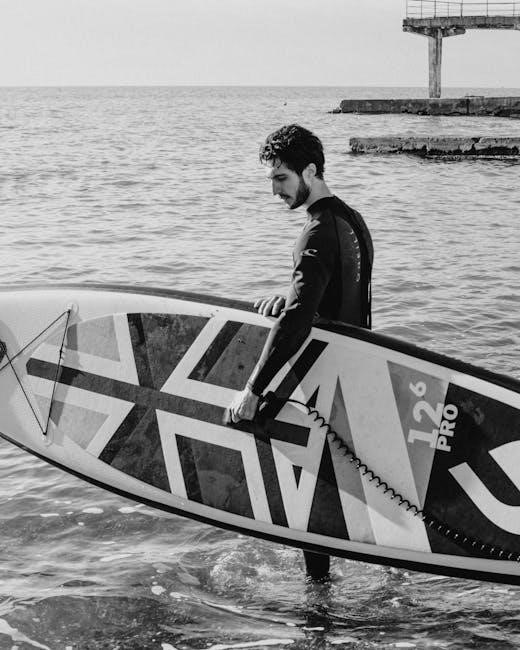
Choosing the right paddle board size is paramount for an enjoyable and safe experience on the water. Factors like rider weight, skill level, and intended use significantly impact the optimal board dimensions. A board that’s too small will feel unstable and difficult to paddle, while one that’s too large can be cumbersome and slow.
Understanding volume, length, width, and thickness is key to finding the perfect fit. Generally, boards range from 9 to 14 feet in length, 28 to 35 inches in width, and 4 to 6 inches in thickness. Weight capacity typically falls between 200 and 500 pounds, with specialized boards exceeding these limits. This guide will help you navigate these considerations, ensuring you select a board tailored to your needs.
Understanding Volume and its Importance
Volume, measured in liters, is arguably the most critical factor in paddle board sizing. It directly correlates to buoyancy and a board’s ability to support a rider’s weight. Insufficient volume results in a board that sits too low in the water, making it unstable and prone to tipping. Conversely, excessive volume can make the board feel sluggish and difficult to maneuver.
Calculating ideal volume based on your weight is essential. Generally, a good starting point is to multiply your weight (in kilograms) by 0.6 to determine the minimum required volume. Consider your skill level; beginners benefit from higher volumes for increased stability. Understanding volume ensures optimal floatation and a more enjoyable paddling experience.
Paddle Board Dimensions: Length, Width, and Thickness
Paddle board dimensions – length, width, and thickness – collectively dictate performance characteristics. Length influences speed and tracking, while width impacts stability. Thickness determines buoyancy and stiffness. These factors are interconnected; altering one affects the others.
Longer boards generally paddle faster and straighter, ideal for touring, while shorter boards are more maneuverable. Wider boards offer greater stability, beneficial for beginners or those paddling in choppy water. Thicker boards provide increased volume and rigidity, supporting heavier riders. Choosing the right combination depends on your weight, skill level, and intended use.
Paddle Board Length and its Impact
Paddle board length significantly affects speed, tracking, and maneuverability. Longer boards, typically exceeding 12 feet, glide efficiently through the water, covering more distance with each stroke – perfect for touring and racing. Shorter boards, under 10 feet, excel in maneuverability, making them ideal for surfing or recreational paddling.
Increased length enhances directional stability, reducing the need for constant correction. However, longer boards can be harder to turn. Conversely, shorter boards are nimble but require more effort to maintain a straight course. Consider your paddling style and primary use when selecting a length; a versatile all-around board often falls between 10’ and 11’.
Paddle Board Width and Stability
Paddle board width is a primary determinant of stability. Wider boards, generally 32 inches or more, offer exceptional stability, making them excellent choices for beginners, yoga, or paddling with children or pets. This increased width provides a larger platform, reducing the likelihood of tipping.
Narrower boards, typically under 30 inches, are faster and more efficient, favored by experienced paddlers and racers. However, they demand greater balance and core strength. A balance must be struck between stability and performance; a moderate width (30-32 inches) often suits all-around paddling. Consider your skill level and intended use when choosing a width, prioritizing stability if you’re new to the sport.
Paddle Board Thickness and Buoyancy
Paddle board thickness directly impacts buoyancy and rigidity, influencing both weight capacity and paddling efficiency. Thicker boards (5-6 inches) displace more water, providing greater buoyancy and supporting heavier riders or larger loads. They also offer increased stiffness, particularly crucial for inflatable boards, enhancing performance and reducing flex.

Thinner boards (4-5 inches) are lighter and more maneuverable, favored by experienced paddlers seeking responsiveness. However, they may have lower weight capacities and exhibit more flex, especially in choppy conditions. Choosing the right thickness depends on your weight, skill level, and the type of paddling you plan to do. Generally, heavier paddlers benefit from thicker boards.
Weight Capacity: Matching Board to Rider
Understanding a paddle board’s weight capacity is paramount for safety and performance. Exceeding the limit compromises stability and can hinder maneuverability, while being significantly under the limit might result in a sluggish ride. Most standard SUPs accommodate between 200-500 pounds, but specialized boards offer wider ranges.
Children’s boards have lower capacities due to their smaller dimensions. Accurately assessing your weight, including gear, is crucial. Consider future use – will you be carrying a child or pet? Volume (measured in liters) is a key indicator; more volume equates to greater buoyancy and capacity. Choosing a board with sufficient capacity ensures a safe and enjoyable paddling experience.
Weight Capacity Ranges for Different Boards
All-around boards typically support paddlers up to 250 pounds, offering versatility for various conditions. Touring boards, designed for longer distances, often handle up to 300 pounds, prioritizing efficiency. Racing boards, focused on speed, may have slightly lower limits around 220 pounds, catering to lighter, performance-oriented paddlers.
Inflatable boards generally range from 275 to 400 pounds capacity, offering portability without sacrificing substantial weight support. Heavier paddlers (over 200lbs) should seek boards exceeding 250 liters in volume. Always check manufacturer specifications, as ranges vary significantly. Prioritizing a board with ample capacity ensures stability and prevents submersion, enhancing safety and enjoyment.
Calculating Ideal Volume Based on Weight
Determining the ideal paddle board volume, measured in liters, is crucial for optimal performance. A general guideline suggests approximately 1 liter of volume for every kilogram (2.2 lbs) of rider weight. Therefore, a 70kg (154lbs) paddler would ideally need a board around 70 liters.
However, this is a starting point. Consider skill level and intended use. Beginners benefit from more volume for increased stability. Experienced paddlers may prefer less volume for enhanced maneuverability. Adding 5-10 liters for children or gear is recommended. Always consult manufacturer specifications, as volume is a key indicator of buoyancy and weight capacity.
Paddle Board Types and Recommended Sizes
Different paddle board types cater to various activities, influencing ideal sizes. All-around boards, versatile for flatwater and small waves, typically range from 10’6” to 11’6” in length and 31-32” in width. Touring boards, designed for longer distances, are longer (12’6”+) and narrower (28-30”) for efficiency.

Racing boards prioritize speed, featuring lengths of 12’6” to 14’ and widths around 28”. Inflatable boards offer portability, with sizes mirroring hard boards, but consider slightly increased width for stability. Choosing the right type and size ensures a comfortable and enjoyable paddling experience, matching your needs and skill level.
All-Around Paddle Boards: Versatility and Size
All-around paddle boards are the most popular choice, excelling in diverse conditions. Their versatility stems from a balanced design, suitable for beginners and experienced paddlers alike; Typically, these boards measure between 10’6” and 11’6” in length, offering a good blend of stability and maneuverability.
Widths generally fall within the 31-32” range, providing ample space and buoyancy. Thickness around 5” is common, ensuring sufficient volume for various rider weights. Ideal for recreational paddling, yoga, and light touring, all-around boards offer a forgiving platform for learning and exploring. They are a fantastic starting point for anyone entering the world of SUP.
Touring Paddle Boards: Length and Efficiency
Touring paddle boards prioritize speed and efficiency over short distances. These boards are designed for covering ground, making them perfect for longer paddles and exploring waterways. Characteristically, touring SUPs are longer and narrower than all-around models, typically ranging from 12’6” to 14’ in length.
Widths usually fall between 28-30”, reducing drag and enhancing glide. Thickness is often around 5-6”, providing ample volume for gear and stability. Increased length contributes to faster speeds, while the narrower profile demands a bit more balance. They are excellent for fitness paddling and multi-day adventures.
Racing Paddle Boards: Speed and Dimensions
Racing paddle boards are engineered for maximum speed and performance in competitive settings. These boards feature a streamlined design, prioritizing efficiency and minimizing drag. Typically, racing SUPs are the longest and narrowest of all board types, often exceeding 14’ in length and measuring around 27-28” in width.
Thickness generally ranges from 4.75” to 6”, balancing buoyancy with hydrodynamic efficiency. The narrow profile demands significant core strength and balance, making them less suitable for beginners. Construction often utilizes lightweight materials to further enhance speed. These boards are built for direct, powerful paddling and achieving the fastest times possible.
Inflatable vs. Hard Paddle Boards: Size Considerations

Choosing between inflatable and hard paddle boards impacts size considerations. Inflatables generally offer more volume for a given length, enhancing stability, particularly for beginners or those prioritizing recreational use. Hard boards, conversely, often feature narrower profiles and refined shapes for performance.
Inflatable boards compensate for construction limitations with wider designs. Hard boards allow for more precise sizing based on rider weight and skill. PSI (pounds per square inch) is crucial for inflatable board rigidity; higher PSI equates to a firmer, more performance-oriented ride. Both types come in various sizes, but understanding these nuances ensures optimal selection.
Paddle Board Size Chart by Rider Weight
Selecting the correct paddle board size hinges on rider weight. Below is a general guide, but skill level and water conditions also matter. For paddlers under 125 lbs (56kg), boards 31-32 inches wide, 5 inches thick, and 96-109 inches long are recommended.
Individuals weighing 125-150 lbs benefit from boards around 31-32 inches wide, 5 inches thick, and 10’2”-11’ long. Paddlers between 150-180 lbs should consider 32-33 inch widths, 5-6 inch thickness, and lengths of 10’6”-11’6”. Heavier paddlers (180-200 lbs) require 33-34 inch widths, 6 inch thickness, and 11’-12’ lengths. Those over 200 lbs need boards exceeding 250 liters of volume.
Under 125 lbs (56kg): Recommended Sizes
For paddlers weighing less than 125 lbs (56kg), stability and maneuverability are key. An all-around board in the 9’6” to 10’9” length range is ideal, offering a balance of both. Width should fall between 31-32 inches, providing ample surface area for easy paddling and reduced tipping. A thickness of 5 inches delivers sufficient buoyancy without sacrificing responsiveness.
Volume is also crucial; aim for boards around 150-200 liters. Inflatable boards are a great option, offering portability and forgiving characteristics. Narrower boards enhance speed, but prioritize width for beginners. Consider a slightly wider board for increased stability in choppy conditions. These dimensions ensure a comfortable and controlled paddling experience.
125-150 lbs: Optimal Board Dimensions

Paddlers between 125-150 lbs will find optimal performance with boards ranging from 10’ to 11’ in length. A width of 31-32 inches continues to provide excellent stability, accommodating various skill levels. Maintaining a 5-inch thickness ensures adequate buoyancy for comfortable paddling and carrying capacity. Volume should ideally be between 200-250 liters, offering a sweet spot for efficiency and control.

All-around boards remain a versatile choice, but exploring touring shapes can enhance glide. Inflatable options are still viable, offering convenience and durability. Consider a slightly narrower board if prioritizing speed, but maintain sufficient width for stability, especially in less-than-ideal conditions. These dimensions deliver a balanced and enjoyable experience.
150-180 lbs: Finding the Right Fit
Paddlers weighing 150-180 lbs generally thrive on boards between 10’6” and 11’6” long. Maintaining a width of 31-32 inches provides a solid platform, balancing stability with maneuverability. A 5-6 inch thickness is recommended, increasing buoyancy to comfortably support the rider’s weight and gear. Optimal volume falls within the 220-280 liter range, ensuring efficient paddling and preventing excessive sinking.
Touring boards become increasingly appealing for longer distances, offering improved tracking. Consider a slightly wider board if prioritizing stability, particularly for beginners. Inflatable boards remain a practical option, while hard boards offer enhanced stiffness and performance. Finding the right fit ensures a fun and efficient experience on the water.
180-200 lbs: Size Recommendations for Heavier Paddlers
Paddlers in the 180-200 lbs range require boards offering ample buoyancy and stability. Look for lengths between 11’ and 12’, with widths of 32-34 inches. A thickness of 6 inches or greater is crucial to support the increased weight and prevent the board from feeling submerged. Ideal volume typically falls between 280-350 liters, ensuring optimal performance and a comfortable ride.

Consider a touring or all-around board with a higher weight capacity. Inflatable boards can work, but ensure the PSI is maximized for rigidity. Prioritize boards specifically designed for heavier paddlers, as they offer enhanced stability and efficiency. Careful selection guarantees a safe and enjoyable paddling experience.
Over 200 lbs: Choosing a Board with Sufficient Capacity
Paddlers exceeding 200 lbs necessitate boards with substantial volume and robust construction. Prioritize lengths of 11’6” to 12’6”, coupled with widths of 33-36 inches. A board thickness of at least 6 inches is essential for adequate buoyancy. Volume should exceed 350 liters, potentially reaching 400+ liters for optimal performance and reduced sinking.

Focus on touring or all-around boards explicitly rated for higher weight capacities, often up to 500 lbs. Inflatable boards require diligent inflation to the maximum PSI. Stability is paramount; wider boards are generally preferable. Selecting a board designed for heavier individuals ensures a safe, efficient, and enjoyable paddling experience.
Advanced Considerations: Skill Level and Water Conditions
Beyond weight, skill level and water conditions significantly impact optimal board size; Beginners benefit from wider, longer boards (11’ to 12’) prioritizing stability, even if slightly slower. Experienced paddlers can opt for narrower, shorter boards (10’6” to 11’) for enhanced maneuverability and speed.
Flatwater paddling allows for longer, narrower boards, maximizing efficiency. Choppy water demands wider, thicker boards for increased stability and to handle waves. Consider board shape; displacement hulls excel in tracking, while planing hulls offer quicker turns. Adjusting size based on these factors ensures a safe and enjoyable experience tailored to your abilities and environment.
Beginner Paddlers: Prioritizing Stability
For novice stand-up paddle boarders, stability is paramount. Opt for wider boards, generally 31-32 inches, as this significantly enhances balance and reduces the likelihood of tipping. Lengths between 10’6” and 11’6” provide a good balance of stability and maneuverability.
Thicker boards (5 inches or more) further contribute to buoyancy and stability, accommodating a wider range of weights. All-around shapes are ideal, offering versatility for various water conditions. Don’t prioritize speed initially; focus on mastering balance and paddling technique on a stable platform. A larger volume board will make learning much easier and more enjoyable.
Experienced Paddlers: Performance and Maneuverability
Skilled paddle boarders can leverage narrower and longer boards for enhanced performance. Reduced width (28-30 inches) minimizes drag, increasing speed and efficiency. Touring boards, often 12’6” or longer, excel in covering distance, while racing boards prioritize speed with even narrower profiles.
Experienced paddlers can handle less volume, allowing for quicker turning and more responsive handling. Consider board shape – pointed noses cut through water efficiently. Adjust thickness based on weight and desired buoyancy. Prioritize maneuverability for surfing or navigating challenging conditions, or length for efficient paddling.
Flatwater vs. Choppy Water: Adjusting Size Accordingly
Calm, flatwater conditions favor longer, narrower boards, maximizing glide and speed. These boards (30-32” wide) are efficient for touring and distance paddling. However, in choppy water, a wider board (32-34”) significantly improves stability, preventing tipping and providing a more comfortable ride.
Increased volume is crucial in choppy conditions, offering better buoyancy and the ability to handle waves. Shorter boards are more maneuverable in rough water, allowing for quicker adjustments. Consider a thicker board for added stability and to displace more water. Adapt your board choice to the prevailing conditions for optimal control and enjoyment.
Paddle Board Specifications: Key Terms to Know
Understanding key specifications is vital when selecting a paddle board. Liters (Volume) represent the board’s buoyancy, directly impacting its weight capacity and stability – higher liters support heavier riders. Length affects speed and tracking, while width influences stability; wider boards are more stable. Thickness contributes to buoyancy and stiffness.
For inflatable boards, PSI (Pounds per Square Inch) indicates inflation level; higher PSI results in a stiffer, more performance-oriented board. Weight capacity is the maximum rider weight the board can safely support. Knowing these terms ensures you choose a board suited to your needs and paddling style.
Liters (Volume): A Detailed Explanation

Volume, measured in liters, is arguably the most crucial paddle board specification. It dictates the board’s buoyancy and ability to support a rider’s weight. A higher volume means greater floatation and stability, essential for beginners or heavier paddlers. Conversely, lower volume boards are less stable but offer enhanced maneuverability.
Calculating ideal volume involves considering rider weight; generally, more weight requires more liters. Boards typically range from 100 to 300+ liters. Understanding volume helps match the board to your weight, ensuring optimal performance and a safe, enjoyable paddling experience. It’s a key factor in determining overall board performance.
PSI (Pounds per Square Inch): For Inflatable Boards
PSI, or pounds per square inch, is a critical measurement for inflatable stand-up paddle boards (iSUPs). It indicates the air pressure within the board and directly impacts its rigidity and performance. Higher PSI results in a firmer, more stable board, closely mimicking the feel of a hardboard.
Most iSUPs recommend a PSI between 15-25 PSI, though some can handle higher pressures. Proper inflation is vital; under-inflation leads to a soft, unstable board, while over-inflation risks damage. Always adhere to the manufacturer’s recommended PSI for optimal performance and longevity. A quality pump with a gauge is essential for accurate inflation.
Resources for Further Research
Expanding your knowledge of paddle board sizing requires exploring dedicated resources. Cruiser SUP offers detailed specifications and measurements for their boards, aiding informed decisions. Online retailers frequently provide size guides and customer reviews, offering practical insights.
Paddle and RDMANetwork’s GitHub repository showcases technical aspects of paddleboard technology. Forums and communities dedicated to SUP enthusiasts provide valuable discussions and firsthand experiences. The Inertia publishes gear reviews and articles covering SUP trends. ERNIE PaddleOCR and PaddleNLP offer insights into AI applications within the sport. Remember to cross-reference information and prioritize manufacturer recommendations.